
0%
Loading ...


When a water heater starts acting up, most homeowners face the same uncomfortable question almost immediately. Should it be repaired, or is it time to replace it altogether? The decision often feels urgent because hot water is not a convenience. It is part of daily routines, comfort, and household stability.
For homeowners in Austin, this choice is rarely straightforward. Local water conditions, system age, usage patterns, and repair history all influence whether fixing the issue makes sense or whether replacement is the smarter long-term move.
This guide is built as a practical decision framework. Instead of pushing assumptions or generic advice, it focuses on clear signals that help determine when repair is reasonable, when replacement is justified, and how to evaluate both options logically.
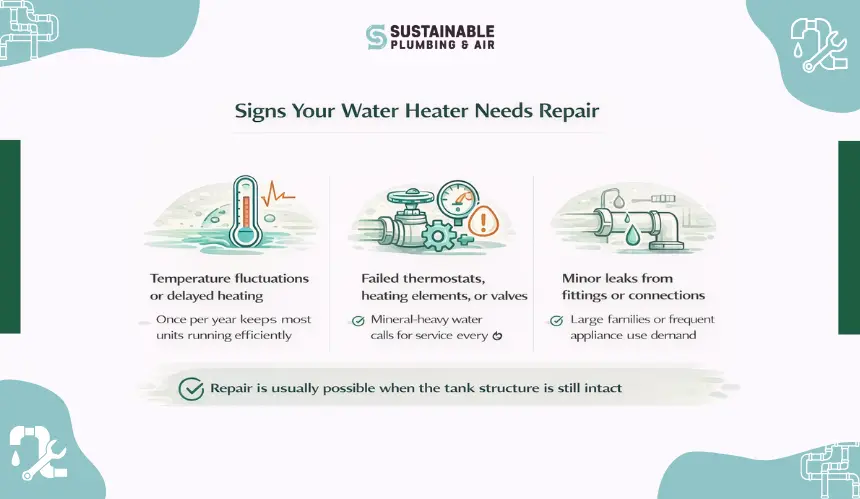
Not every water heater problem indicates system failure. Many issues originate from individual components wearing out rather than from structural damage. Identifying repair-appropriate symptoms early allows homeowners to restore performance without committing to unnecessary replacement.
Performance inconsistency is one of the most common repair-level concerns. Fluctuating water temperatures, delayed heating cycles, or brief drops in hot water supply typically stem from thermostat miscalibration, heating element wear, or sediment interfering with heat transfer. These issues affect how efficiently the system operates but do not compromise the tank itself.
Because these problems are functional rather than structural, targeted component repairs often restore stable performance without shortening the remaining service life of the water heater.
Water heaters are built with serviceable components designed to be replaced over time. Failures involving thermostats, heating elements, pressure relief valves, or electronic control boards usually occur independently of the tank. When these components malfunction, repairing or replacing the affected part resolves the issue without altering the core system.
This distinction is critical because component failure does not indicate internal corrosion or tank degradation. Repair remains appropriate when the problem is isolated to parts meant to wear gradually.
Small leaks do not automatically require replacement. Moisture from fittings, valves, or pipe connections often results from seal fatigue or pressure relief discharge. These leaks occur outside the tank structure and are typically correctable through focused repairs.
The determining factor is leak location. External leaks are manageable, while water collecting at the base of the tank often points to internal deterioration. Accurate diagnosis prevents premature replacement decisions.

Some indicators point to irreversible decline where repairs no longer provide dependable or safe operation. In these situations, replacement becomes a preventive step rather than a reactive one.
Water heater aging affects internal components long before failure becomes visible. Traditional tank systems generally reach the end of reliable operation between eight and twelve years. As internal linings degrade, corrosion accelerates even if hot water output appears normal.
Once a system reaches this stage, repairs can no longer address the underlying wear. Replacement shifts the focus from short-term restoration to long-term reliability.
Recurring service calls often signal diminishing returns. When multiple repairs occur within a short period, wear is no longer isolated. Each fix may address a symptom, but overall system reliability continues to decline.
As cumulative repair costs increase, replacement becomes the more stable and predictable option. The decision is driven by risk exposure rather than a single repair expense.
Rust-colored water, visible corrosion, or metal degradation inside the tank indicate internal failure. These conditions develop once the anode rod and protective lining can no longer prevent corrosion. At this point, repairs cannot restore structural integrity.
Continued operation increases the likelihood of tank rupture and water damage, making replacement unavoidable.
Replacement is sometimes necessary even when a system still functions. Household changes such as increased occupancy, additional bathrooms, or higher usage patterns can exceed the system’s design capacity.
When hot water consistently runs out during normal use, the limitation is structural, not repairable. Upgrading system capacity resolves demand issues that repairs cannot address.

With symptoms clearly identified, the decision depends on evaluating cost, performance, and risk together rather than in isolation. This section brings those factors into a practical decision framework.
The most effective comparison measures cost against remaining service life. When a single repair or a series of repairs exceeds 40–50 percent of the cost of a new water heater, the financial value of continued repairs begins to decline. At that point, the expense is often buying short-term functionality rather than long-term reliability.
A repair that restores several years of dependable operation may still offer value. However, repairs that provide only temporary relief increase uncertainty and long-term expense. Viewing the decision through a lifecycle cost lens helps homeowners avoid reactive choices based solely on immediate price.
Efficiency loss develops gradually, often going unnoticed. Older systems frequently consume more energy due to sediment accumulation, heat loss, and outdated efficiency standards. Even when operational, they can drive higher monthly utility costs.
Replacement becomes financially reasonable when improved efficiency offsets the initial investment over time.
Safety risk increases as internal wear progresses. Corrosion raises the likelihood of leaks, pressure stress, and unexpected shutdowns. A system that poses credible flooding or safety concerns shifts the decision toward replacement rather than continued repair.
Reliability is not only about comfort but also about protecting the home from preventable damage.
Local conditions across the greater Austin area influence how water heaters age, perform, and fail. While climate and water quality are shared regionally, neighborhood characteristics often determine whether repair remains practical or replacement becomes the safer option.
In established areas such as Tarrytown and Westlake, many homes still rely on older plumbing infrastructure. Aging supply lines and original installations often place added stress on water heaters, making repeated repairs less predictable once systems reach mid-to-late lifespan.
Communities like Barton Creek and Lost Creek typically feature larger homes with higher hot water demand. In these settings, capacity strain and continuous usage can accelerate wear, shifting the decision toward replacement when performance becomes inconsistent.
In growing suburbs such as Cedar Park and Round Rock, newer construction may still experience early efficiency loss due to hard water sediment buildup. Even relatively young systems can face declining performance, making efficiency upgrades a stronger factor in the repair versus replacement evaluation.
Lake-adjacent communities like Lakeway often see increased mineral exposure and fluctuating demand from seasonal occupancy. These conditions can shorten component life and complicate long-term repair planning, especially once internal corrosion begins.
Across all these areas, year-round water heater use and hard water conditions limit recovery periods and accelerate internal wear. As a result, replacement decisions in the Austin region are often driven by reliability, efficiency, and risk management rather than visible failure alone.

Once the warning signs and decision factors are clear, the next step is turning that clarity into action. This stage is not about rushing into repair or replacement. It is about reducing uncertainty and avoiding decisions made under pressure.
Timing matters more than many homeowners realize. Waiting until a system fully fails often limits options and increases costs. A professional performed evaluation by a professional water heater expert in Austin when symptoms first appear allows for accurate diagnosis, realistic repair projections, and clear replacement planning. This approach gives homeowners control over timing rather than reacting to a sudden loss of hot water.
In areas throughout Austin, early inspections are especially valuable due to hard water conditions that can hide internal wear until performance drops suddenly.
Having the right information upfront prevents guesswork. Homeowners should confirm the system’s age, fuel type, capacity, and repair history before weighing options. Understanding whether past issues were isolated or recurring helps clarify whether the system is stabilizing or continuing to decline.
Documenting recent performance changes also improves decision accuracy, as gradual inefficiency often goes unnoticed without comparison.
Emergency replacements are rarely ideal. They limit equipment choices, reduce scheduling flexibility, and often result in higher total cost. Planning replacement before structural failure allows homeowners to select appropriate capacity, efficiency levels, and installation timing without urgency.
Even when repair remains viable, having a replacement plan in place reduces risk exposure and prevents last-minute decisions driven by inconvenience rather than value.
Hard water accelerates mineral sediment buildup inside water heaters, which reduces heat transfer efficiency and increases internal stress. Over time, this leads to higher energy usage and faster component wear. In Central Texas, untreated hard water can shorten effective system lifespan even if no visible failure is present.
Replacing a water heater before failure often results in better outcomes. Planned replacement allows homeowners to choose the right capacity, efficiency level, and installation timing. Waiting for full failure increases the risk of water damage and limits equipment options, often leading to rushed decisions rather than value-driven ones.
Sediment flushing can improve efficiency and reduce strain on heating components, but it does not reverse internal corrosion. For newer systems, flushing supports longevity. For aging systems, it may improve short-term performance without significantly extending remaining service life, making it a maintenance aid rather than a long-term solution.
Tankless systems offer efficiency and longer lifespan potential, but they are not universally better. Installation requirements, household demand, and upfront cost all influence suitability. In some homes, upgrading to a high-efficiency tank system provides better value and simpler integration than switching to tankless technology.
A water heater can continue operating after warranty expiration, but risk increases significantly. Once the warranty ends, manufacturers no longer cover tank failure, and internal corrosion is more likely. Continued operation becomes a risk management decision rather than a reliability-based one, especially for older systems.