
0%
Loading ...


A Quick answer: There is no universally better option between a tank and a tankless water heater. The right choice depends on how your home uses hot water, including household size, usage timing, available space, and existing utility capacity.
Tank water heaters are generally better for homes with predictable, moderate hot water demand, where multiple fixtures are not used heavily at the same time; for replacement or installation, explore our water heater installation and replacement services.
Tankless water heaters are better suited for homes that prioritize energy efficiency and on-demand hot water delivery, especially where usage patterns vary throughout the day; check out our tankless water heater repair and installation services.
Choosing between these two water heater types often feels more complicated than it should. Many homeowners focus on trends or upfront pricing, but real satisfaction comes from matching the system to daily routines and physical limitations inside the home.
This guide breaks down how tank and tankless water heaters differ in function, performance, efficiency, and practicality, helping homeowners make a confident, well-aligned decision without guesswork.

Before comparing efficiency, costs, or suitability, it helps to understand how each system actually produces hot water. The difference is not just about storage versus speed. It is about when water is heated, how energy is used, and what happens during everyday demand inside the home. These mechanics shape everything that follows.
Tank water heaters operate by continuously heating a fixed volume of water stored inside an insulated tank. Once the water reaches a set temperature, the system maintains it until hot water is drawn from a faucet or appliance. As hot water leaves the tank, it is replaced by cold water, which is then reheated during the recovery cycle.
This design works well in many homes across Austin, TX, especially older properties in areas like Tarrytown or Barton Creek, where utility layouts were originally built around storage-based systems. The system’s performance depends on tank capacity, recovery rate, and how evenly hot water is used throughout the day.
Tankless water heaters heat water only when it is needed. Instead of storing hot water, these systems activate when a hot water tap is opened, sending cold water through a heat exchanger that raises the temperature instantly. Once the tap is closed, energy use stops.
This approach aligns well with homes in Westlake, Lakeway, or newer developments around Cedar Park and Round Rock, where space efficiency and modern electrical or gas infrastructure are more common. Performance is tied to flow rate rather than stored volume, which means the system can run continuously but has limits on how many fixtures it can support at the same time.
Once the operating mechanics are clear, the next concern for most homeowners is how each system performs during everyday routines. Morning showers, dishwashers running, laundry cycles, and multiple fixtures being used at once place very different demands on a water heater. These moments reveal performance differences that are not always obvious on paper.
Tank water heaters supply hot water until the stored volume is depleted. When demand exceeds the tank’s capacity, hot water output drops until the system reheats the incoming cold water.
In households with predictable usage patterns, this limitation is manageable, especially when showers and appliances are spaced throughout the day.
In many Austin homes with consistent routines, including family properties in Lost Creek or Tarry Town, this behavior aligns well with daily habits.
Performance is influenced by tank size, recovery speed, and how often multiple fixtures draw hot water at the same time; ensure optimal function with professional water heater maintenance. Once the tank is emptied, recovery time becomes the controlling factor for availability.
Tankless water heaters do not store hot water, so they do not “run out” in the traditional sense. Instead, performance depends on how much water the system can heat at once. When multiple fixtures operate simultaneously, flow rate becomes the limiting factor rather than stored volume.
This distinction is especially relevant in larger or more modern homes around Westlake, Lakeway, and newer developments in Cedar Park and Round Rock, where bathrooms, kitchens, and laundry rooms may be used at the same time.
While tankless systems provide consistent temperature during continuous use, exceeding the system’s flow capacity can reduce pressure or temperature at individual fixtures.

Energy efficiency is often one of the main reasons homeowners consider changing water heater types, according to the U.S. Department of Energy water heater efficiency guidelines. While both systems can meet hot water needs, the way they consume energy over time affects monthly utility bills and long-term operating costs.
These differences become more noticeable in regions with fluctuating seasonal demand and high summer energy usage, like Central Texas.
Tank water heaters consume energy even when no hot water is being used; the EPA Energy Star guide for water heaters helps homeowners select high-efficiency models. Because water is stored at a set temperature, the system must periodically reheat it to compensate for heat escaping through the tank walls. This process, known as standby heat loss, contributes to ongoing energy consumption throughout the day.
In Austin, TX, where water heaters often work harder during cooler winter mornings and again during high-demand summer evenings, standby loss can subtly increase utility costs.
Homes in established neighborhoods such as Barton Creek or Lost Creek may also have older tanks with lower insulation standards, which can amplify this effect over time.
Tankless water heaters only draw energy when hot water is actively being used. Once the tap is closed, the system stops consuming power or gas, eliminating standby losses entirely.
This on-demand operation can lead to lower overall energy use in homes with irregular or spread-out hot water demand.
This efficiency model aligns well with newer homes in areas like Westlake or Lakeway, where energy-conscious construction and modern utility infrastructure are more common.
However, actual savings depend on usage patterns rather than system type alone. High, continuous demand can narrow the efficiency gap, especially during peak usage hours.

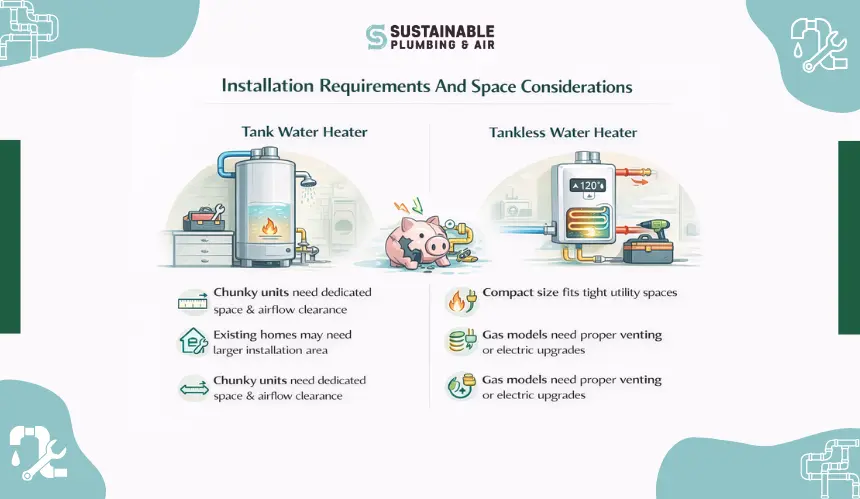
Beyond performance and efficiency, installation realities often determine which water heater type actually makes sense for a home; our emergency water heater services can handle urgent replacements or repairs. Physical space, venting options, and existing utility connections can either simplify the upgrade process or introduce costly limitations. These factors vary widely depending on when and how a home was built.
Tank water heaters require a dedicated area large enough to accommodate the tank itself, along with clearance for ventilation and maintenance access. In many older Austin, TX, homes, especially in neighborhoods like Tarry Town or Barton Creek, water heaters are commonly installed in garages, utility closets, or outdoor enclosures designed around these larger units.
Tankless systems have a much smaller physical footprint, which allows for flexible placement on walls or in compact utility spaces. However, reduced size does not eliminate venting needs.
Gas-powered tankless units often require upgraded venting systems to safely handle higher exhaust temperatures, while electric models depend on sufficient electrical capacity rather than airflow.
Utility capacity plays a major role in determining whether a tankless system is practical. Electric tankless water heaters may require electrical panel upgrades to handle higher amperage demands. Gas tankless systems often need larger gas lines to support rapid heating output.
In newer developments around Cedar Park, Round Rock, and parts of Lakeway, homes are more likely to have modern electrical panels and gas sizing that can support these upgrades with minimal modification.
In contrast, retrofitting older homes in central Austin or Lost Creek can involve additional work that affects installation cost and complexity.
Price is often the most immediate factor in a water heater decision, but focusing only on the initial purchase can be misleading. True ownership value is shaped by installation complexity, maintenance needs, and how long the system performs reliably in everyday use.
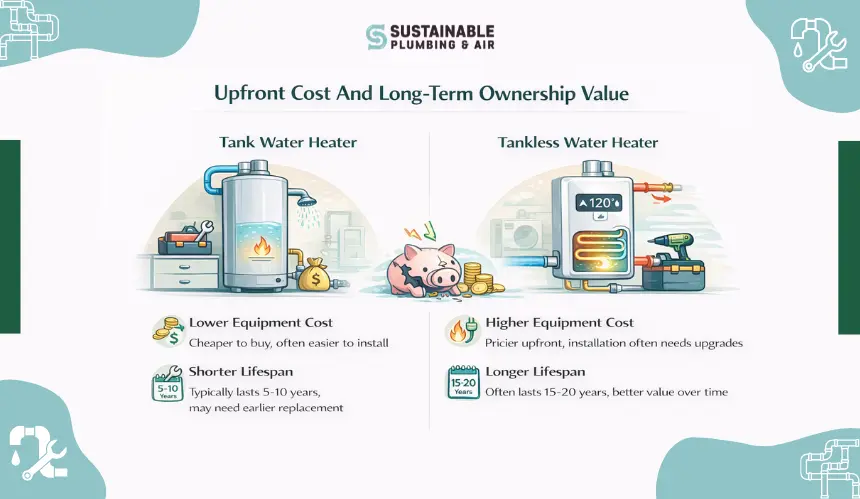
Tank water heaters generally have a lower upfront cost. The equipment itself is less expensive, and installation is usually straightforward when replacing an existing unit.
In many Austin, TX, homes, especially those already configured for tank systems, this makes replacement faster and more predictable.
Tankless systems usually involve a higher initial investment. Beyond the unit price, installation may require electrical upgrades, gas line adjustments, or venting modifications.
In areas like Westlake or Lakeway, where newer homes are designed with higher utility capacity, these costs can be easier to manage. In older neighborhoods such as Tarry Town or Lost Creek, additional infrastructure work can significantly affect the final price.
Tank water heaters typically have a shorter service life due to constant exposure to stored water, sediment buildup, and corrosion. Routine flushing can extend performance, but many systems still reach replacement age sooner.
Tankless water heaters are designed for longer operational life when properly maintained. Periodic descaling is essential, particularly in Central Texas, where mineral content in the water supply can accelerate buildup inside heat exchangers. While maintenance costs may be
Once costs, performance, and installation factors are understood, the decision becomes more straightforward when tied directly to household behavior.
Water heaters deliver the best results when their design matches how hot water is used on a daily basis, not when choices are made based on trends or assumptions.
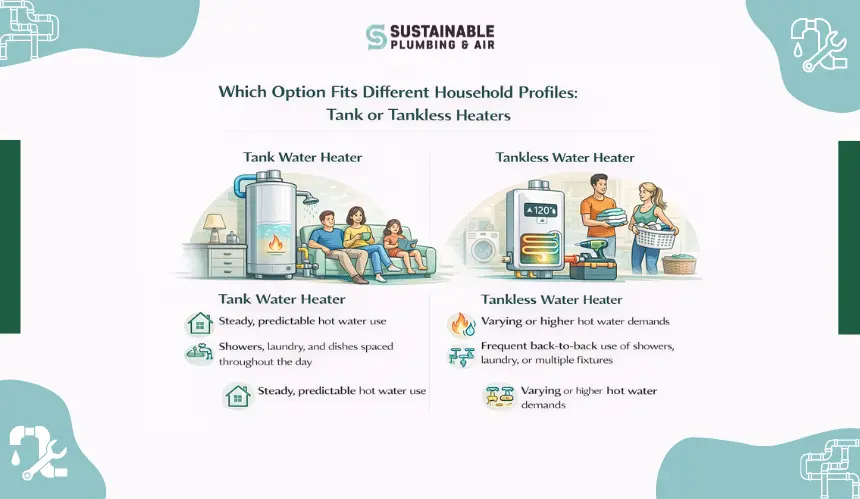
Tank water heaters work well in homes with steady, predictable hot water use. When showers, laundry, and dishwashing are spaced throughout the day, stored capacity is rarely strained.
This makes tank systems a practical option for households with moderate occupancy and routine schedules.
Tankless water heaters are better suited for households with varying or higher hot water demands. Homes that experience frequent back-to-back usage or rely on multiple fixtures at the same time benefit from on-demand heating that does not depend on stored volume.
In some situations, practical factors outweigh preference. Limited space, restricted utility capacity, or budget constraints can make one system more realistic than the other.
Evaluating these limitations alongside usage patterns helps ensure the chosen system performs reliably without unexpected complications.
Choosing between a tank and a tankless water heater does not have to feel overwhelming; learn more with our why professional water heater replacement prevents plumbing issues guide. When the decision is based on real usage, infrastructure, and long-term value, the right option becomes clear. Sustainable Plumbing & Air helps homeowners evaluate those factors with honest guidance and practical insight, ensuring the water heater choice fits the home.
Replacing a water heater with a different system type typically takes longer than a direct replacement because permitting, utility upgrades, venting changes, and inspections may be required. In most cases, a same-type replacement is completed within 3 to 6 hours.
A tank-to-tankless or tankless-to-tank conversion usually takes 1 to 2 days, depending on electrical or gas upgrades, venting modifications, and inspection scheduling.
Hard water can significantly affect tankless water heaters by causing mineral scale buildup inside the heat exchanger. Without periodic descaling, performance and efficiency decline over time. Water quality plays a more critical role in tankless systems than many homeowners realize.
Tankless water heaters can be appealing to buyers who value energy efficiency and modern home systems. While they do not guarantee a higher sale price, they are often viewed as an upgrade that signals long-term efficiency and lower operating costs.
During a power outage, most tankless water heaters stop operating because they rely on electricity for ignition and control systems. Tank water heaters may continue to provide limited hot water if they use gas and the stored water is already heated.
Local building codes can influence which water heater systems are permitted and how they must be installed. Requirements related to venting, seismic strapping, energy efficiency, and utility connections can affect both system selection and installation scope.