
0%
Loading ...


If you own a tankless water heater in Austin, you have probably heard conflicting advice. Some plumbers say annual descaling is mandatory. Others call it optional. Homeowners in neighborhoods like Circle C Ranch, Mueller, or Avery Ranch often wonder whether this is a real requirement or just preventive maintenance upselling.
This article gives a direct answer to whether annual descaling is legally required, warranty-required, or practically necessary in Austin.
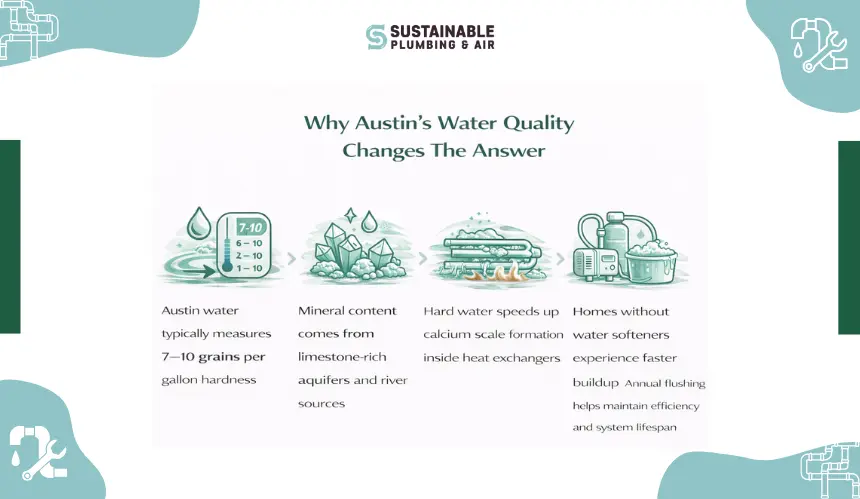
Tankless water heaters heat water instantly through a compact heat exchanger. In Austin, where water flows through limestone-rich sources managed by Austin Water, dissolved calcium and magnesium minerals enter the system daily. When heated, these minerals harden into calcium carbonate deposits that attach to the inner walls of the heat exchanger.
This mineral scaling restricts water flow and reduces heat transfer efficiency. Even a thin layer of lime buildup can force the unit to work harder, increasing energy consumption and triggering temperature fluctuations or error codes.
Descaling removes these deposits through a controlled flushing process, restoring proper flow, protecting internal components, and maintaining long-term system efficiency.
No, annual descaling is not legally required in Austin. However, most manufacturers require routine maintenance to keep the warranty valid, and Austin’s hard water often makes yearly service the safest approach.
The confusion usually comes from mixing up plumbing code requirements with manufacturer maintenance guidelines. These are two separate standards, and understanding that difference clears up most of the uncertainty.
The City of Austin does not mandate annual descaling under local plumbing codes. Regulations focus on installation compliance, gas line sizing, venting, and safety inspections. Once a tankless water heater passes inspection, ongoing maintenance becomes the homeowner’s responsibility.
This means properties in areas such as Hyde Park, South Congress, or Circle C Ranch are not subject to penalties or citations for skipping yearly flushing. The city ensures safe installation, not maintenance frequency.
Most tankless manufacturers outline routine descaling in their warranty terms. If mineral scale damages the heat exchanger and no service documentation exists, warranty claims can be denied.
In Austin’s limestone-influenced water conditions, annual flushing often aligns with manufacturer recommendations. While not a legal mandate, it becomes a practical requirement for preserving warranty protection and avoiding costly heat exchanger replacement.

Whether annual descaling feels excessive or essential depends largely on water chemistry. In Austin, mineral content plays a bigger role than many homeowners realize.
The city’s supply, influenced by limestone formations and treated through Austin Water facilities drawing from the Colorado River basin, contains measurable levels of calcium and magnesium that contribute to scale formation.
Austin’s water typically falls in the moderately hard to hard range, often testing between 7 and 10 grains per gallon, depending on the season and treatment adjustments. That level is high enough to accelerate calcium carbonate deposits inside a tankless heat exchanger.
Homes in areas supplied by water sourced from Lake Travis and Lake Austin may notice heavier mineral spotting on fixtures, glass shower doors, and faucets.
Those same dissolved minerals travel through the tankless unit daily. Compared to soft-water regions in the Pacific Northwest, scaling occurs faster in Central Texas due to the limestone-rich aquifers surrounding the region.
If a home does not use a whole-home water softener, annual descaling becomes a preventative measure rather than an optional upgrade. High hot water demand, such as in larger households or properties with multiple bathrooms, increases mineral exposure and accelerates scale buildup.
In these conditions, skipping yearly flushing can shorten the lifespan of the heat exchanger and increase energy consumption. While some softer-water cities may allow longer intervals between service appointments, Austin’s mineral profile often shifts the recommendation toward an annual maintenance schedule for consistent performance and warranty protection.

Skipping annual descaling does not usually cause immediate failure. However, in Austin’s hard water environment, the impact builds quietly inside the heat exchanger. Over time, mineral scaling reduces efficiency, increases operating stress, and raises the risk of expensive internal damage.
Within the first year of neglected maintenance, most systems show subtle performance changes. Homeowners may notice longer wait times for hot water, fluctuating output temperature, or slightly higher utility bills. These shifts occur because calcium deposits restrict water flow and reduce thermal transfer inside the heat exchanger.
Many tankless units eventually trigger diagnostic fault codes tied to overheating protection or flow irregularities. These alerts are often misinterpreted as sensor malfunctions, yet in hard water conditions, mineral buildup is frequently the root cause.
Early intervention through professional water heater services in Austin can restore internal efficiency before permanent damage develops.
If scale accumulation continues for multiple years, thick mineral layers trap heat inside the exchanger. This forces the system to operate at higher internal temperatures, increasing wear on critical components. Over time, that stress can lead to heat exchanger cracking or internal corrosion.
At this stage, descaling alone may not resolve the problem. Major component replacement becomes more likely, and repair costs rise significantly. Preventative maintenance reduces that long-term risk and helps preserve both system lifespan and consistent performance in Austin’s mineral-heavy water conditions

For many homeowners, the real question is financial. Is routine maintenance worth paying for every year, or is it safe to wait until something fails? In Austin’s hard water conditions, the cost difference between prevention and repair is significant.
Professional descaling typically ranges between $150 and $350, depending on system type and service complexity. The process usually takes 60 to 90 minutes and includes flushing the heat exchanger, inspecting isolation valves, and checking diagnostic codes.
Compared to rising utility bills caused by scaling-related inefficiency, routine maintenance often pays for itself through improved performance and preserved warranty coverage.
If scaling leads to internal damage, heat exchanger replacement can cost $1,200 to $3,000, including parts and labor. In some cases, full unit replacement becomes more practical than repair.
Beyond the repair bill, downtime can disrupt daily routines, especially in multi-bath households. When comparing costs, preventative service is significantly more predictable than emergency replacement.
Not every home has identical maintenance needs. The following checklist helps determine whether annual descaling is strongly recommended in your situation.
Quick Qualification Checklist
This structured approach allows homeowners to base the decision on water conditions, usage patterns, and system performance rather than guesswork.
Hard water should not shorten the life of your tankless system. If you are unsure whether annual descaling is necessary for your home, a professional evaluation can give you clarity. The experts at Sustainable Plumbing & Air understand Austin’s water conditions and can assess scaling risk, efficiency levels, and warranty compliance in one visit.
In Austin’s mineral-rich water conditions, a properly maintained tankless system can last 15 to 20 years. Without consistent maintenance, the lifespan may shorten due to internal scale accumulation and heat exchanger stress. Water quality and usage levels both influence durability.
Yes, mineral deposits can gradually narrow internal water pathways inside the heat exchanger. This restriction may reduce flow rate over time, even if overall household pressure appears normal. Internal scaling often develops before noticeable pressure drops occur at fixtures.
Routine maintenance helps maintain optimal heat transfer efficiency. When internal surfaces remain clean, the system heats water more efficiently and avoids excessive fuel or electricity consumption. Over time, this supports consistent performance and lower operational strain.
Yes. Preventative inspections can detect early mineral accumulation, sensor irregularities, or combustion issues before symptoms appear. Waiting for visible signs often means internal stress has already progressed beyond early-stage buildup.
Tankless systems use compact heat exchangers with narrow water channels. Because water flows directly across heating surfaces, mineral deposits impact performance more quickly compared to traditional storage tank models. This design makes water quality a more significant factor in maintenance planning.