
0%
Loading ...

Tankless water heaters are often associated with endless hot water, but their real-world performance depends on how they respond to sustained, simultaneous demand and proper tankless water heater installation. High-usage households frequently experience conditions that test flow capacity, heating speed, and internal regulation.
Homeowners researching tankless water heaters in Austin often compare expectations with real-world experience, especially when multiple fixtures are used simultaneously and consider tankless water heater repair to maintain peak performance. Understanding how these systems behave under load helps clarify when performance is operating as designed and when internal or installation-related limitations may be present.
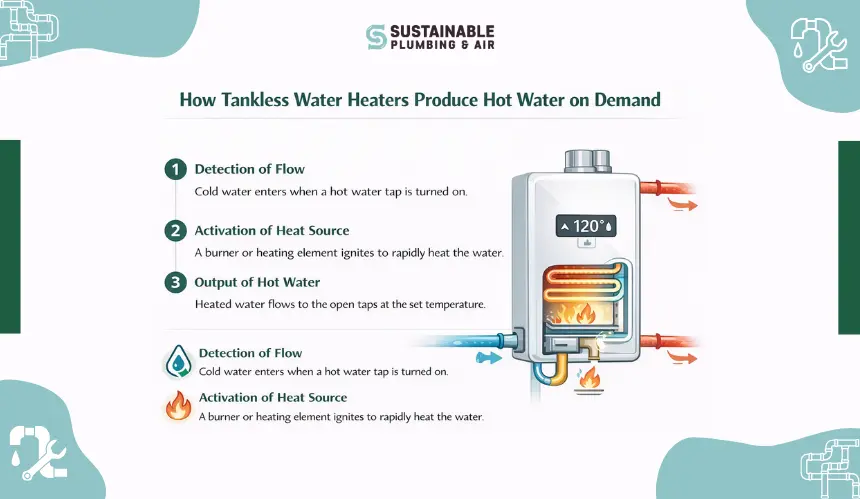
Unlike storage tanks, tankless systems heat water only when flow is detected, as explained in Department of Energy guidelines on tankless water heaters. This design changes how the system reacts when demand increases across multiple fixtures.
Tankless units are rated in gallons per minute, which indicates how much water they can heat to a target temperature at once. When combined demand exceeds this threshold, the system cannot fully compensate, resulting in reduced output temperature or prioritization across fixtures. This behavior reflects capacity limits rather than system failure.
The amount of heating required depends on the incoming water temperature. Colder inlet water requires more energy to reach the desired output. During periods of high demand, the system must balance flow volume with temperature rise, which can limit the number of fixtures that receive consistent hot water simultaneously.

High-demand scenarios often involve concurrent use of showers, appliances, and sinks. How the system distributes heat during these moments determines perceived performance.
Most tankless systems do not automatically prioritize fixtures. Instead, they divide available heating capacity across all active flows. When several fixtures draw hot water simultaneously, each may receive slightly cooler water as the system distributes its heating capacity to meet total demand.
Temperature fluctuation during simultaneous use is often misinterpreted as a malfunction, which can be resolved with professional water heater maintenance. In reality, the system is operating at its maximum capacity and adjusting output dynamically. This behavior becomes more noticeable in larger households or during peak usage windows such as mornings or evenings.
Did you know? Many perceived tankless “failures” are actually capacity mismatches between household demand and system size.

Tankless systems rely on sensors and control boards to continuously regulate temperature, a feature monitored by our water heater services.
Flow and temperature sensors constantly relay data to the control board, which adjusts heating output in real time. Under heavy demand, these adjustments happen rapidly and repeatedly. While this maintains system safety and efficiency, it can introduce slight temperature variation when demand fluctuates quickly.
Extended high-demand use increases operating temperature and duty cycles for internal components. Over time, this stress can accelerate wear if maintenance is deferred. While the system is designed for continuous use, long-term performance depends on proper calibration and periodic service.
Water pressure plays a supporting role in how tankless heaters respond to demand, even though heating capacity remains the primary constraint.
When multiple fixtures operate simultaneously, pressure is divided across the plumbing system. Reduced flow at individual fixtures can affect the heater’s demand sensing, occasionally triggering brief temperature fluctuations as flow rates fluctuate.
Tankless systems require a minimum flow rate to activate heating. In high-demand scenarios where pressure drops below activation thresholds at certain fixtures, the heater may cycle on and off, causing intermittent temperature fluctuations that appear unpredictable.

System sizing and installation quality directly affect how well a tankless heater handles heavy use.
A unit sized for average use may struggle in homes with multiple bathrooms or frequent appliance use. Undersizing forces the system to operate at full capacity more often, increasing temperature variation and long-term wear during peak demand.
Long pipe runs and a lack of recirculation can delay hot water delivery, which becomes more noticeable when multiple fixtures are in use. While not a heating failure, this delay can affect user perception of performance under load.
Maintenance plays a critical role in ensuring consistent performance during high-demand conditions.
Mineral scale reduces heat transfer efficiency, forcing the system to work harder to meet demand. Under heavy load, this inefficiency becomes more apparent, leading to temperature instability or reduced output, even when the system was previously adequate.
Sensors exposed to scale or debris may report inaccurate readings, causing the control system to misadjust heating output. Regular service helps maintain accurate regulation and smoother performance during peak usage periods.
High-demand situations often expose problems that remain hidden during light use.
Tankless heaters require sufficient energy input to meet heating demand. Inadequate electrical capacity or inconsistent gas pressure can limit output during peak use, causing noticeable temperature drops even if the unit itself is functioning correctly.
Repeated performance decline under heavy use can indicate heating element fatigue, burner issues, or control board stress. Addressing these signs early prevents escalation into system failure.
No. It provides continuous hot water within its rated flow capacity, not unlimited simultaneous volume.
Total demand exceeds heating capacity, requiring output allocation.
In some cases, staged or dual systems improve capacity when demand is consistently high.
Yes. Scale buildup and sensor drift significantly reduce efficiency under load.
Not always. It often reflects system limits rather than a malfunction.
Tankless water heaters perform efficiently when their capacity matches actual household usage patterns. High-demand conditions reveal how well the system balances flow, temperature rise, and internal regulation under pressure. When performance limitations appear, accurate assessment helps determine whether the issue lies in sizing, installation, maintenance, or energy supply rather than the technology itself. Homeowners evaluating performance concerns often consult experienced professionals, such as Sustainable Plumbing, to analyze demand patterns and ensure the system’s behavior aligns with household needs through residential plumbing services.