
0%
Loading ...


Water heaters in Austin fail earlier than many homeowners expect, and the reason often starts with the city’s mineral-heavy water supply. In neighborhoods like Circle C Ranch, Mueller, and areas fed by treatment plants drawing from the Colorado River, hardness levels regularly register above national averages.
This breakdown explains how local water chemistry interacts with heater design, why failure timelines shorten in Central Texas, and what that means for system durability and long-term operating cost.

Before examining internal heater damage, it is important to understand the chemistry of the water entering the system. Austin’s supply, regulated by Austin Water, primarily draws from the Lower Colorado River Authority system, including Lake Travis and Lake Austin.
The surrounding limestone geology significantly influences mineral composition. Water hardness here is not accidental. It is geologically embedded.
Important: According to publicly available water data, Austin’s tap water typically measures between about 7 and 10 grains per gallon of hardness, placing it solidly in the hard water category rather than soft or moderately hard. |
Water hardness refers to the concentration of dissolved calcium and magnesium ions, typically measured in grains per gallon or parts per million. In many parts of Austin, including Westlake Hills, Steiner Ranch, and South Austin, hardness levels frequently fall within the hard to very hard range on the U.S. Geological Survey classification scale.
The primary contributor is calcium carbonate, formed as groundwater and surface water interact with limestone and dolomite formations common across Central Texas. As water travels through these rock layers, it dissolves mineral content, increasing total dissolved solids and hardness concentration.
From a chemistry standpoint, this mineral load remains dissolved at normal temperatures. The water appears clear and harmless when entering plumbing lines.
However, once exposed to elevated temperatures inside a heating appliance, its equilibrium shifts. That shift triggers reactions that fundamentally change how the water behaves inside a closed heating system.

Once mineral-rich water enters a heater, chemistry shifts into physics and material stress. The internal environment of a water heater is a controlled pressure vessel where temperature, pressure, and dissolved solids interact continuously.
In a hard water region like Austin, those interactions intensify mechanical strain on internal components.
When cold water containing calcium bicarbonate is heated, its chemical stability changes. At elevated temperatures, dissolved bicarbonate converts into solid calcium carbonate. This reaction is not gradual dilution. It is crystallization.
Inside a storage tank, these mineral crystals detach from solution and settle along the tank floor. In tankless systems, they adhere to narrow heat exchanger coils where water velocity slows. The higher the water temperature, the faster this precipitation occurs. Homes that set thermostats above 130°F accelerate this reaction cycle even further.
This process is known as limescale formation. It is not dirt entering the system. It is a mineral transformation caused directly by thermal input. Over repeated heating cycles, sediment layers accumulate, forming a compacted mineral bed.
Water heaters rely on direct thermal contact. Gas burners transfer BTUs through the tank base, while electric models use submerged heating elements. When sediment layers form between the heat source and the water, thermal conductivity drops.
Calcium carbonate acts as an insulating barrier. Heat must travel through the mineral layer before reaching the water column. That resistance forces burners or elements to operate longer to achieve the same temperature rise.
Extended run times increase fuel consumption and electrical draw. Over time, this creates burner overcycling in gas systems and element stress in electric models. The efficiency loss is measurable. Even a few millimeters of scale can reduce heat transfer performance significantly.
Sediment accumulation does more than reduce efficiency. It alters heat distribution patterns. Beneath a compacted mineral layer, temperatures can spike in concentrated zones. These hot spots expose the steel tank and glass lining to uneven thermal expansion.
Repeated expansion and contraction cycles weaken the internal lining. Microfractures may form in the protective coating. Once that barrier is compromised, water contacts the steel substrate directly, initiating corrosion.
In high-hardness areas such as Northwest Austin near Four Points or older homes around Hyde Park, prolonged exposure to mineral scale accelerates anode rod depletion. The sacrificial rod corrodes faster because electrochemical protection must work harder in a mineral-rich environment.
This chain reaction, from mineral precipitation to localized overheating to corrosion, explains why water heaters in hard water regions experience structural degradation earlier than systems operating in softer water markets.
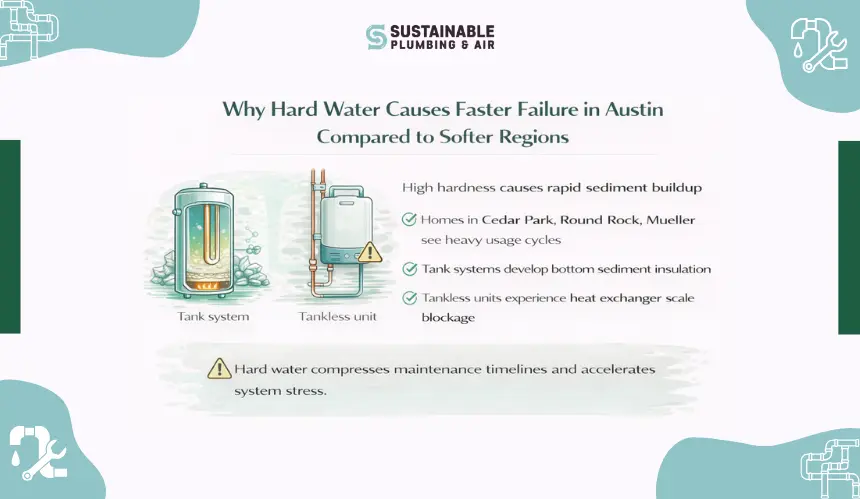
Not all hard water environments produce identical wear patterns. What accelerates failure in Austin is the combination of mineral concentration, refill frequency, and household demand cycles.
In growing areas like Cedar Park, Round Rock, and developments near Mueller, daily hot water usage is high. That means repeated heating cycles, repeated mineral precipitation, and faster internal accumulation.
In regions where water hardness exceeds 7 grains per gallon, mineral saturation builds rapidly with each heating cycle. Austin commonly falls within this range, which means sediment does not accumulate slowly over a decade. It compounds steadily from year one.
Every time fresh water enters the tank, it introduces new dissolved calcium and magnesium ions. Over time, this increases sediment stratification at the base of storage tanks. In softer water regions, the same heater may require flushing every two to three years. In Austin, annual flushing is often necessary to maintain performance.
The difference lies in mineral density per gallon. Higher hardness translates to more scale per cycle. The result is accelerated buildup timelines and compressed service intervals.
Storage tank systems accumulate sediment primarily at the bottom of the tank. This creates insulation over the burner area, reduces efficiency, and increases structural stress.
Tankless systems face a different vulnerability. Their narrow heat exchanger channels are designed for rapid thermal exchange. When scale forms inside those narrow pathways, flow rate restriction occurs. This may trigger system error codes related to overheating or insufficient water movement.
In Austin homes with tankless units installed in compact mechanical closets or garages, scaling inside copper or stainless steel heat exchangers can reduce output capacity noticeably. Descaling intervals must be shorter compared to installations in soft water regions.
While both system types suffer from mineral deposition, the failure mechanism differs. Tanks degrade structurally from the bottom up.
Tankless units experience internal coil obstruction and thermal sensor strain. In high-hardness areas, both scenarios advance faster than in markets with lower mineral concentrations.

Hard water damage does not begin with a leak. It begins with subtle operational changes that most homeowners dismiss as normal aging. In Austin, where mineral concentration is consistently elevated, these performance shifts tend to appear earlier in a heater’s service life.
Recognizing the pattern of symptoms helps distinguish mineral-related degradation from unrelated mechanical defects.
One of the earliest signs is abnormal sound during heating cycles. Popping, crackling, or rumbling noises occur when trapped water beneath compacted mineral layers rapidly converts to steam.
These sounds are most noticeable in quiet environments, especially in garage-mounted units common in Circle C Ranch or utility closets in East Austin townhomes.
Another performance shift involves extended heating duration. Gas burners or electric elements may operate longer than usual to achieve set temperatures. This results in delayed recovery between uses and shorter periods of consistent hot water output.
Households in high-demand neighborhoods such as Mueller or Steiner Ranch often detect this change first during peak usage times. The heater still functions, but its responsiveness declines. These acoustic and recovery patterns are operational signals that internal thermal efficiency is compromised.
Physical evidence may appear gradually rather than dramatically. Rust-tinted hot water can indicate internal tank wall exposure following protective lining stress. Minor seepage around fittings or pressure relief components may emerge as internal stress increases.
Anode rod inspection frequently reveals accelerated depletion in hard water environments. The sacrificial metal erodes faster when mineral content elevates electrochemical activity inside the tank. While this component is designed to corrode first, rapid consumption suggests increased internal strain.
In tankless systems, scale accumulation within the heat exchanger can trigger intermittent system shutdowns or diagnostic error codes related to temperature sensors. These signals differ from tank-based symptoms but still reflect mineral-related internal wear.
Each of these signs represents a distinct manifestation of material stress rather than simple age-related decline. When evaluated together, they form a clear diagnostic profile consistent with high-hardness operating conditions.
Understanding visible symptoms is important, but long-term impact is measured in years of lost service life and rising operational costs. In mineral-heavy markets like Austin, water heaters rarely reach the upper end of their manufacturer-rated lifespan without consistent intervention.
The difference is not theoretical. It is measurable through replacement frequency and efficiency decline over time.
Under moderate water conditions, a standard storage tank water heater typically operates between 8 and 12 years. In high-hardness environments such as Southwest Austin, Westlake, and developing corridors near Leander, that range often compresses to 6 to 8 years depending on maintenance practices and demand load.
Tankless systems, while marketed with longer expected lifespans, are not immune. Their heat exchangers are engineered for rapid thermal transfer, which makes them highly sensitive to internal mineral restriction. Without scheduled descaling, performance deterioration can begin within a few years of installation.
The shortened lifespan is not due to inferior manufacturing. It results from sustained exposure to elevated mineral concentrations interacting with thermal cycling inside a pressurized system. Over time, internal wear accumulates faster than in softer water regions.
Beyond structural durability, hard water affects energy consumption patterns. As internal efficiency declines, burners and heating elements operate longer to achieve target temperatures. This increases gas usage in combustion systems and electrical demand in resistance-based units.
In Austin households where energy costs fluctuate seasonally, even a modest efficiency drop can compound into noticeable utility bill increases. The heater may still appear functional, but its cost per gallon of heated water rises.
Over several years, the combined impact of reduced lifespan and elevated energy consumption can exceed the cost of preventative treatment systems. This economic dimension often goes unnoticed because the decline occurs gradually rather than abruptly.
Quantifying these changes highlights that hard water is not simply a maintenance issue. It directly affects appliance longevity, performance consistency, and long-term operating expense within Austin homes.
Once mineral concentration is identified as the stressor, prevention focuses on interrupting the damage cycle before structural wear begins. In Austin homes, especially in areas supplied by the Lower Colorado River Authority system, protection requires engineering controls rather than reactive repairs.
These measures do not eliminate mineral presence in Austin’s water supply. They manage its mechanical impact on heating systems, extending service life and stabilizing operational efficiency.
Preventative maintenance can extend system life, but there is a threshold where structural integrity and internal efficiency decline beyond practical recovery. At that stage, continued repair becomes financially inefficient and mechanically unreliable.
When mineral damage reaches the point where repairs no longer make financial or structural sense, the right guidance matters. Sustainable Plumbing & Air helps Austin homeowners evaluate whether restoration or full replacement is the smarter long-term move.
If your water heater is showing signs of irreversible wear, schedule a professional assessment and make a confident decision before a sudden failure disrupts your home.
According to public water quality summaries from Austin Water, hardness levels commonly fall between 7 and 10 grains per gallon. This places Austin in the hard water category.
Some parts of North Texas measure slightly higher, while coastal regions often report lower mineral concentration. Austin consistently ranks above the national average for hardness.
Many manufacturers include language requiring routine maintenance in hard water regions. Failure to flush sediment or descale tankless heat exchangers can lead to denied warranty claims if scale buildup is documented.
Homeowners should review warranty terms carefully and maintain service records to protect coverage eligibility.
Tankless systems provide high energy efficiency and compact design benefits, but they still require scheduled descaling in hard water environments. The advantage lies in their longer overall lifespan potential when properly maintained. Without maintenance, scale-related performance loss can occur quickly, similar to storage tank units.
Dishwashers, washing machines, and ice makers are also exposed to dissolved minerals. Hard water can reduce appliance efficiency, cause spotting on glassware, and contribute to internal valve wear. Addressing hardness at the point of entry benefits the entire plumbing system, not just the heater.
Austin building codes do not mandate residential water softener installation. However, many homeowners choose softening systems as a preventative investment due to mineral concentration levels. The decision is typically based on appliance longevity goals and maintenance planning rather than regulatory requirements.
Water quality reports are published annually by Austin Water, but individual households may test hardness levels every one to two years, especially after plumbing upgrades or system replacements. Testing helps verify whether mineral concentration aligns with maintenance scheduling and appliance protection strategies.