
0%
Loading ...

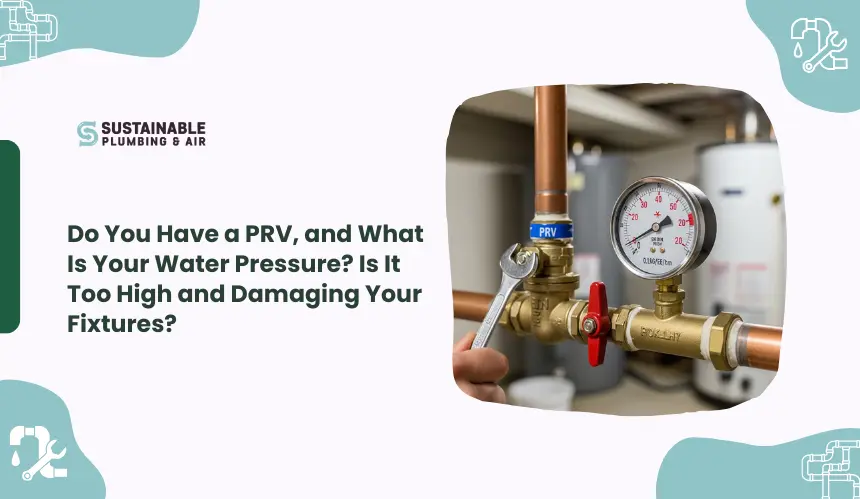
You turn on the faucet expecting a steady flow, but instead you hear a sharp thud in the pipes. Your shower feels forceful. A toilet keeps running. These small signs often point to one overlooked issue: excessive water pressure inside the plumbing system.
This article focuses on helping you determine whether your home has a PRV, how to identify unsafe water pressure levels, and what those readings mean for the health of your fixtures.
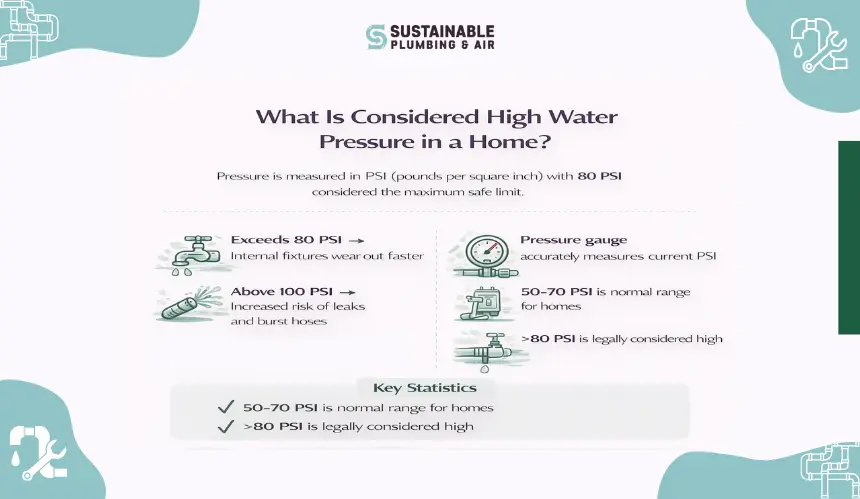
Water pressure is measured in pounds per square inch, commonly referred to as PSI. Most residential plumbing systems are designed to operate between 50 and 70 PSI. According to widely adopted plumbing standards such as the International Residential Code, 80 PSI is the maximum allowable static pressure for a home’s water system.
When static pressure consistently exceeds 80 PSI, it is officially considered high. At that level, internal components such as faucet cartridges, toilet fill valves, appliance solenoids, and water heater connections experience accelerated wear. Even if leaks are not visible, seals and threaded joints endure continuous mechanical stress.
Pressure readings above 100 PSI significantly increase the risk of hose ruptures, relief valve discharge, and premature fixture failure. This is why testing actual PSI with a calibrated water pressure gauge is critical before assuming the system is within a safe range.
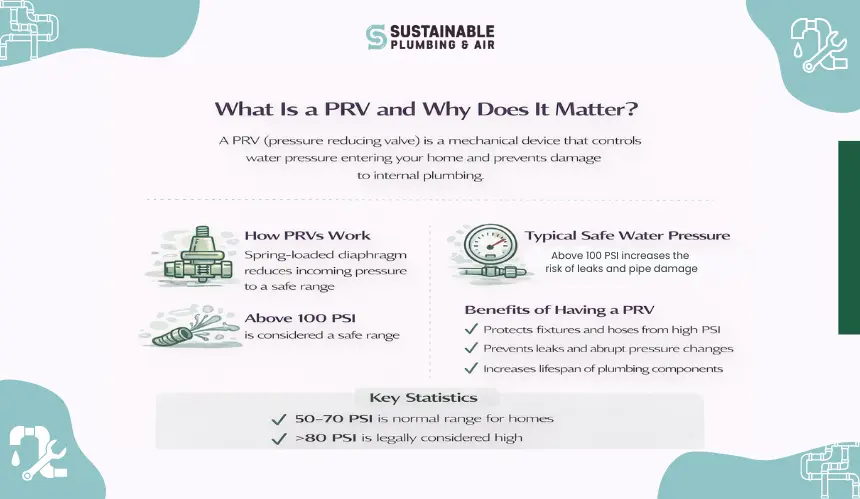
PRV stands for pressure-reducing valve. It is a mechanical device installed on the main water supply line that controls how much pressure enters your home. Municipal water systems often deliver water at pressures well above what residential plumbing fixtures are designed to handle. Without regulation, that force travels directly through pipes, valves, and appliance connections.
Inside the valve, a spring-loaded diaphragm responds to incoming pressure from the city supply. When the PSI exceeds the preset level, the internal mechanism restricts flow to maintain a consistent downstream pressure. This process protects branch lines, faucet cartridges, toilet fill valves, and washing machine hoses from unnecessary stress.
Most residential systems are calibrated to maintain pressure between 50 and 70 PSI. Plumbing standards generally consider 80 PSI the upper safe threshold. Anything beyond that increases strain on seals and threaded connections, even if leaks are not immediately visible.
High water pressure does not always announce itself with a burst pipe. In many homes, the warning signs are subtle at first. The plumbing system continues functioning, but internal components begin wearing down faster than they should. Recognizing these early indicators helps prevent fixture damage before it becomes expensive.
One of the most common indicators is frequent dripping from faucets even after cartridges have been replaced. Excess pressure forces water past internal seals, weakening them over time. Toilets that continue running or refill aggressively can also point to elevated PSI stressing the fill valve assembly.
You may also hear banging or knocking sounds inside the walls when a faucet or washing machine shuts off. This condition, often associated with water hammer, becomes more pronounced when pressure levels are high. Sudden force changes create shockwaves that travel through copper, PEX, or CPVC piping.
Another overlooked signal is a water heater temperature and pressure relief valve that intermittently discharges water. While thermal expansion can contribute to this issue, consistently high static pressure increases the likelihood of relief valve activation.
At the entry point of the home, excessive pressure may cause subtle vibration around the main shut-off valve or meter assembly. Over time, threaded fittings or unions near the supply line can develop minor leaks. These are often misinterpreted as aging components when the underlying issue is unmanaged PSI.
If a water pressure gauge attached to a hose bib consistently reads above 80 PSI during static testing, that reading confirms high pressure. Readings climbing toward 90 or 100 PSI require prompt evaluation, even if fixtures appear functional.
Excess pressure increases water consumption without homeowners realizing it. Higher flow rates lead to elevated utility bills, especially in households with multiple bathrooms. More importantly, internal appliance components such as dishwasher solenoid valves and washing machine hoses face continuous strain.
Over time, this mechanical stress shortens the lifespan of plumbing fixtures and appliances. Manufacturers often design components with specific pressure tolerances.
Operating above those limits accelerates seal failure and internal corrosion. What feels like strong performance at the tap can quietly reduce the longevity of the entire plumbing system.
Expert Insight: Appliance solenoid valves inside dishwashers and washing machines open and close using electromagnetic components rated for specific pressure ranges. |
In Austin, local infrastructure and climate patterns can influence residential PSI levels in ways homeowners may not immediately connect to fixture wear. The Austin Water utility system serves diverse elevations, from neighborhoods near Lady Bird Lake and Downtown to higher areas in Westlake, Steiner Ranch, and parts of Northwest Austin. Homes located at lower elevations may experience stronger incoming pressure from municipal supply zones.
Seasonal demand also plays a role. During peak summer irrigation months, especially in areas like Circle C Ranch and Mueller, where lawn watering is common, distribution pressures can fluctuate throughout the day. Overnight, when demand drops, static pressure can rise noticeably. This is often when pressure spikes occur inside homes.
Austin’s hard water conditions add another layer of concern. Mineral buildup inside valves and cartridges reduces flexibility in seals. When high PSI combines with calcium scale accumulation, internal components wear out faster.
Homeowners who notice recurring cartridge replacements or relief valve discharge should consider both pressure testing and water quality factors as part of the evaluation.
Important: When municipalities perform hydrant flushing or maintenance, temporary pressure shifts can occur in nearby homes. In some cases, pressure spikes follow system rebalancing after flushing. |

Before making adjustments or assuming a regulator failure, the actual PSI must be measured. Visual signs suggest a problem, but a calibrated reading confirms it. Accurate testing separates guesswork from data and helps determine whether the plumbing system is operating within safe limits.
A simple threaded water pressure gauge provides reliable results. These gauges are commonly attached to an exterior hose bib, laundry sink faucet, or boiler drain valve. Once connected, open the valve fully and allow the gauge to stabilize before reading the PSI.
For most homes, a stable reading between 50 and 70 PSI indicates balanced pressure. If the gauge shows 80 PSI or higher under static conditions, the system exceeds recommended residential standards. Many professional-grade gauges include a red indicator needle that records peak pressure, helping identify spikes that occur overnight when municipal demand is low.
Testing early in the morning often reveals the highest static pressure. Municipal water systems tend to experience pressure increases during low usage periods, which is why overnight readings can expose hidden overpressure conditions.
Static pressure refers to the PSI reading when no water is flowing inside the home. This measurement shows the baseline force applied to pipes and fixtures at rest. It is the primary number used when determining compliance with plumbing code limits.
Dynamic pressure is measured while a faucet or appliance is actively running. This reading reflects pressure under load and can reveal flow restrictions, partially closed valves, or supply line issues. While static pressure identifies overpressure risks, dynamic testing helps evaluate system performance during daily use.
If static pressure is high but dynamic pressure drops sharply, the issue may involve supply line restrictions rather than excessive incoming PSI. A clear distinction between these two readings ensures accurate diagnosis.
If readings fluctuate significantly throughout the day or exceed 90 PSI, a licensed plumber should inspect the pressure-reducing valve and expansion control components. Homes with multi-story layouts, closed plumbing systems, or thermal expansion tanks may require a more detailed pressure analysis.
Professionals may perform extended monitoring using advanced pressure recording devices to detect spikes caused by regulator failure or municipal surges. Confirming consistent, safe PSI protects fixture longevity and prevents unnecessary strain on the plumbing network.
Many homeowners assume a pressure regulator is present simply because the plumbing system appears modern. In reality, not every home is equipped with a pressure-reducing valve. The only way to confirm its presence is through physical inspection and pressure testing.
A pressure-reducing valve is installed on the main water supply line after the municipal meter and before the water branches into the home. In most properties, it is found near the main shut-off valve. Common locations include garages, basements, crawlspaces, or exterior wall entry points where the service line penetrates the foundation.
In slab-on-grade homes, which are common in parts of Texas, the PRV may be positioned near the front hose bib or inside a ground-level access box close to the meter. Its placement depends on how the original plumbing layout was designed.
A PRV usually has a bell-shaped or dome-shaped brass body with an adjustment bolt or screw at the top. Some models include a locknut to secure the calibrated pressure setting. You may also see directional arrows stamped on the housing indicating water flow direction.
Manufacturers often imprint pressure ratings or model information directly on the valve body. If you see a compact brass device with an adjustment mechanism between the shut-off valve and the interior plumbing line, it is likely the regulator.
Older homes built before widespread pressure regulation standards may not have a pressure-reducing valve installed. Properties connected to private wells typically rely on well pressure tanks and switches instead of municipal regulators.
In some neighborhoods, incoming PSI from the water utility may naturally fall within safe ranges, making a PRV unnecessary at the time of construction.
However, municipal infrastructure upgrades or system-wide pressure adjustments can change supply levels over time. This is why physical verification and PSI testing are more reliable than assumptions based on the age or style of the home.
When a home lacks a pressure-reducing valve and incoming PSI exceeds safe limits, the plumbing system absorbs that force continuously.
The damage rarely happens overnight. It develops gradually as internal components experience mechanical stress beyond their design tolerance.
Without regulation, the plumbing system functions under invisible strain. A PRV acts as a protective barrier, reducing incoming municipal pressure to a level that preserves fixture integrity and system stability.
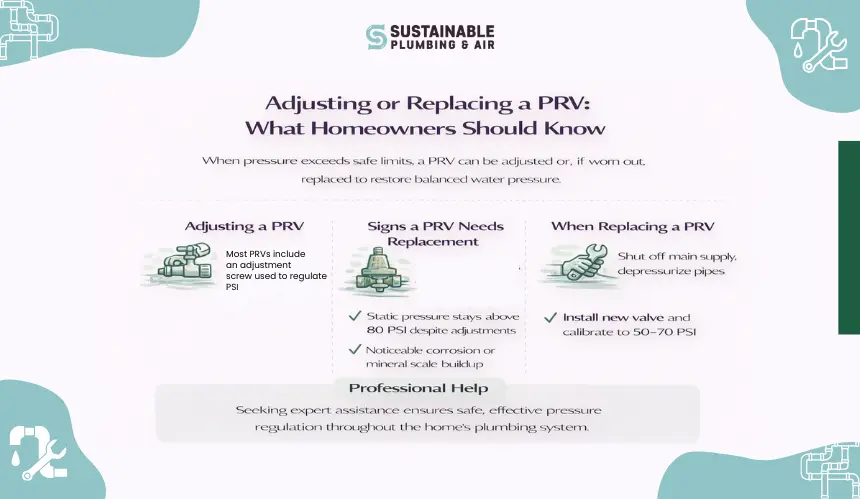
Once high PSI is confirmed, and a pressure-reducing valve is present, the next step is determining whether adjustment or replacement is necessary. Not every elevated reading means the valve has failed, but consistent pressure outside the safe range requires attention.
Most residential pressure-reducing valves include an adjustment bolt at the top of the valve body. Turning this screw clockwise typically increases downstream pressure, while counterclockwise reduces it. Adjustments should be made gradually, followed by immediate PSI verification using a calibrated water pressure gauge.
The goal is to stabilize static pressure between 50 and 70 PSI. Over-adjustment can create inconsistent flow rates or strain the internal diaphragm. If pressure does not respond predictably to adjustments, the regulator may have internal wear or mineral buildup affecting performance.
Pressure regulators do not last indefinitely. Several indicators suggest replacement rather than recalibration:
Internal components such as springs and diaphragms degrade over time, especially in areas with hard water. When these elements weaken, pressure control becomes inconsistent.
Replacing a PRV requires shutting off the main water supply and depressurizing the plumbing system. The old regulator is removed from the service line, and a new valve is installed in the correct flow direction. After installation, pressure must be calibrated and verified under static conditions.
In closed plumbing systems, professionals may also evaluate the thermal expansion tank to ensure balanced pressure management. Proper installation and calibration restore stable PSI and protect fixtures from ongoing mechanical stress.
If your faucets keep dripping, your water heater relief valve releases water, or your pressure readings are climbing past safe limits, it may be time to take action.
Sustainable Plumbing & Air helps homeowners identify high PSI issues, inspect PRVs, and restore balanced water pressure before fixture damage becomes costly. Reach out to us today to prevent major plumbing repairs tomorrow.
Insurance providers may deny claims if damage is linked to long-term maintenance neglect. Many water heater manufacturers specify a maximum operating pressure, often 80 PSI. If internal damage occurs and system pressure exceeds that limit, warranty claims may be denied due to improper operating conditions.
Yes. In slab-on-grade construction, continuous elevated PSI places stress on buried supply lines beneath the concrete foundation. Over time, microfractures can develop in copper or PEX tubing, potentially leading to concealed leaks that require specialized detection and repair.
Mineral-heavy water contributes to calcium scale buildup inside valves and internal plumbing components. When excessive PSI combines with scaling, seals lose flexibility faster and internal passages narrow, intensifying mechanical stress and accelerating component deterioration.
Short-term surges can happen due to municipal system changes, nearby hydrant use, or sudden valve closures. These spikes may not appear during brief gauge readings but can still strain fixtures. Advanced monitoring tools can detect intermittent pressure fluctuations.
High-efficiency faucets or modern fixtures do not correct excessive incoming PSI. While they regulate flow at the outlet, they cannot reduce baseline system pressure. Proper regulation must occur at the main supply line to protect the entire plumbing network.